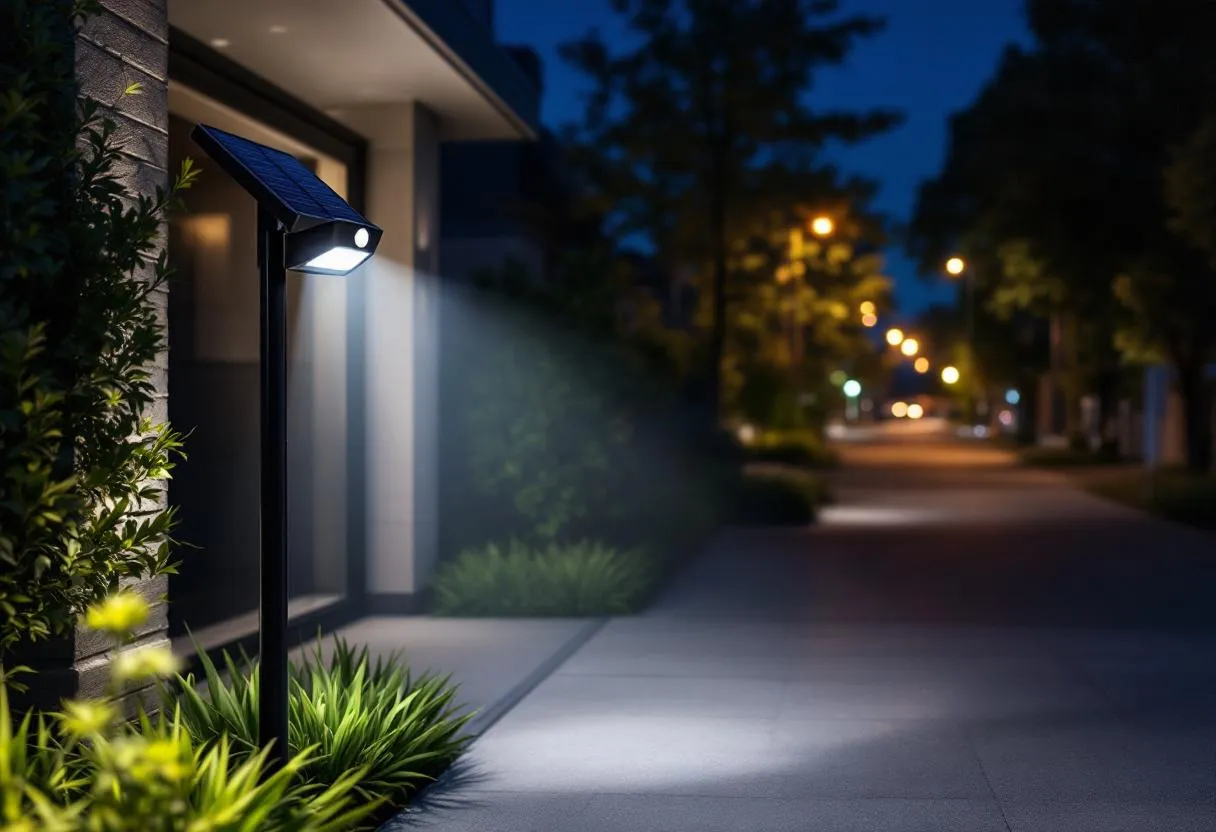
Motion sensor lights are the number one upgrade for home security — and they cost zero dollars to run. Solar motion sensor lights sit outside, soak up free energy during the day, and burst to life the second they detect movement at night. No switches. No wiring. No electricity bills.
Whether you want to light up a walkway for late-night arrivals, scare off porch pirates, or just make your backyard safer, the right motion sensor light makes a huge difference. We tested the top models of 2026 to find the ones with fast triggers, long battery life, and rock-solid weatherproofing.
8 min read • Updated May 2026
📋 Table of Contents
🏆 Top 5 Picks at a Glance
We tested over a dozen solar motion sensor lights. These five stood out for sensor speed, brightness, and durability in 2026.
LITOM 30-LED Solar Motion Sensor Light (2-Pack)
This is the one we come back to again and again. The 30-LED design puts out a clean, bright cone of light the instant the PIR sensor picks up movement. We clocked the trigger at under half a second — fast enough to catch anyone coming through your yard before they reach the door.
Key specs:
- • 30 LEDs with 1000-lumen burst brightness
- • 26-foot motion detection range
- • 120° wide sensor detection angle
- • 2200mAh lithium-ion battery
- • IP65 weatherproof
- • 3 modes: dim-then-bright, motion-only, constant-on
- • 2-pack for whole-yard coverage
ZEEZOO 20-LED Solar Motion Sensor Light
If you want real motion-sensor lighting without spending much, this one delivers. The 20-LED head is plenty bright for a walkway, garage door, or side gate. It is compact, mounts in minutes with two screws, and the sensor fires reliably every time.
Key specs:
- • 20 LEDs, ~600 lumens peak output
- • 16-foot motion detection range
- • 120° sensor coverage angle
- • 1200mAh rechargeable battery
- • IP65 waterproof housing
- • 3 lighting modes (dim, full burst, off)
- • Wall-mount, stake-mount, or tape-mount option
iThird 43-LED Motion Sensor Light with 180° Sensor
This is the light you want when your yard is wide open. The 180-degree sensor covers a full half-circle — motion from the left, right, or straight ahead all triggers it. The 43 LEDs light up the entire width of a standard driveway. One light where two regular ones would sit.
Key specs:
- • 43 LEDs for wide, even illumination
- • 180° motion sensor — full semi-circle coverage
- • 26-foot detection range
- • 2400mAh battery for extended nighttime use
- • IP65 rain and snow rated
- • Daylight sensor — only fires at dusk or after
Aootek 128-LED Solar Flood Light with Motion Sensor
If "bright enough to see everything" is your goal, this is the flood light to get. The 128-LED array puts out serious, stadium-quality light. The motion sensor triggers a full-power flood that makes your whole yard look like a parking lot. Nothing sneaks up past this.
Key specs:
- • 128 LEDs — the brightest pick on this list
- • 30-foot motion detection range
- • 2800mAh high-capacity battery
- • Adjustable solar panel tilt for best charging angle
- • IP65 weatherproof
- • 3 modes including constant-brightness at night, full-power on motion
BAXIA 3-Head Solar Motion Sensor Light
Three heads, three directions. You bend each lamp head to point wherever you need light. Facing left to the driveway, right to the yard, and straight ahead to the door — it gives you near 360° coverage with one unit. The motion sensor covers all angles, so something moves, the closest head fires.
Key specs:
- • 3 rotatable lamp heads — nearly 360° coverage
- • 54 LEDs total (18 per head)
- • 28-foot PIR motion detection range
- • 2200mAh lithium battery
- • IP65 waterproof
- • Wall-mount bracket with adjustable tilt
- • 2 lighting modes
📊 Quick Comparison Table
| Product | Category | Detection Range | Lumens | Verdict |
|---|---|---|---|---|
| LITOM 30-LED | Best Overall | 26 ft | ~1000 lm | All-around champion |
| ZEEZOO 20-LED | Best Budget | 16 ft | ~600 lm | Best value under $20 |
| iThird 43-LED | Best Wide-Angle | 26 ft | ~800 lm | 180° motion sensor coverage |
| Aootek 128-LED | Best Flood Light | 30 ft | ~2000 lm | Brightest light on the list |
| BAXIA 3-Head | Best Multi-Head | 28 ft | ~900 lm | 360° flexible coverage |
Want to see how much real solar panels could save you? Enter your zip code in our free calculator and discover solar incentives available in your area — it only takes a few seconds.
Enter Your Zip Code →🔎 How to Choose a Solar Motion Sensor Light
Buying the right solar motion sensor light comes down to four things. Get these right, and you will never have to think about outdoor lighting again.
📡 Sensor Range and Detection Angle
The range tells you how far away the sensor picks up movement. Budget lights sense motion at about 15 feet, while premium ones reach 26 to 30 feet. The detection angle tells you how wide the sensor "sees."
If you mount a light facing forward and motion comes from the side, a narrow sensor might miss it. Look for at least 120 degrees — wider is better for open areas like driveways. The best models in this guide hit 180 degrees.
💡 Brightness (Lumens) vs Battery Drain
More lumens means a brighter light — but brighter lights also drain the battery faster. This is the trade-off you need to manage.
Most solar motion lights sit in dim mode most of the night and flare to full brightness only when motion is detected. This saves a lot of power. Some models also have a "motion-only mode" where the light stays completely off until the sensor fires, which gives the longest total runtime.
For a walkway or front step, 400 to 800 lumens is plenty. For driveways and backyards where you want maximum visibility, look for 1,000 to 2,000+ lumens.
🌧️ IP Weather Rating
Your motion sensor light sits outside through rain, snow, and summer heat. The IP rating tells you how well it is sealed. IP65 means it is dust-tight and can handle powerful water jets — heavy rain and snow. IP67 goes a step further and means it can survive being submerged briefly.
Never buy a solar motion sensor light rated below IP65. Anything less will eat moisture and die within a season. Every pick on our list meets or exceeds IP65.
☀️ Solar Panel Size and Charging Time
The solar panel on the light does the only job that matters — it captures energy from the sun to charge the battery. A bigger panel collects more energy in less time, which matters on cloudy days or in winter.
Most solar motion sensor lights have a panel on the top that faces upward. Some models have the panel on the back so you can angle it toward the sun. These are better if you are mounting under an eave where the top panel would stay in shade.
Expect a full charge in 6 to 8 hours of direct sun in summer. In winter, it may take closer to 10 to 12 hours of available daylight.
📍 Where to Mount Solar Motion Sensor Lights
Placement is everything. Put a motion sensor light in the wrong spot and it will either never trigger or fire all day at the neighbor's cat. Here is where we recommend mounting for the best results.
🚗 Driveway
Mount lights 8 to 10 feet up on either side of the garage or driveway entrance. Point the sensor outward so it catches cars pulling in and people walking up the drive.
Best picks: Aootek 128-LED (flood style) or the iThird 43-LED with its wide 180° sensor.
🏠 Garage Side/Back
Put one light on the side of the garage pointing at the side gate or side yard. Motion sensors on garage sides are great for catching people who try to hide behind the house, and they light up the pathway to your back door.
Best pick: LITOM 30-LED — the all-rounder works perfectly here.
🚪 Front Door / Entry
Mount 7 to 9 feet high next to the front door, angled slightly downward. This lights up the steps and porch when a guest or delivery person approaches. You get practical lighting and a security bonus.
Best pick: ZEEZOO 20-LED for the budget, LITOM 30-LED for full power.
🌳 Backyard / Patio
Backyards usually need the widest coverage. Mount a multi-head light on a fence corner or on the back of the house. Point each head at a different area — deck, yard, shed — and you get full coverage from one light.
Best pick: BAXIA 3-Head for 360° coverage or the iThird 43-LED for maximum breadth.
❓ Frequently Asked Questions
What range do solar motion sensor lights detect at?
Most solar motion sensor lights pick up movement between 15 and 30 feet away. Budget models hover around 15 to 20 feet, while premium units can sense motion as far as 30 feet away. The detection angle is usually between 120 and 180 degrees — the wider the angle, the more of your yard the light covers without needing a second unit. Keep the sensor pointed toward the area you want to watch, and remove any branches or objects that might block the beam.
Do they only trigger at night?
Yes — all the lights on this list have a built-in daylight sensor (photocell) that keeps the light off during the day. Even if the motion sensor detects a person or car, the light will not turn on when there is enough natural light. This is important because it saves the battery for nighttime when you actually need the light. The photocell is what makes these "dusk to dawn" lights — they wake up when the sun goes down.
How high should I mount a solar motion sensor light?
The sweet spot is 6 to 10 feet off the ground. Mounting in this range gives the sensor a good downward angle so it catches a person's full body and the ground in front of them. If you mount too high (like on a two-story roof), the sensor angle may be too steep and miss people directly below. If mounted too low, the motion beam may be blocked by fences or shrubs. Also, higher mounting angles the LED light beam wider, so it spreads coverage over a bigger area.
Will solar motion sensor lights survive the winter?
They will work through winter, but with a caveat: shorter days and less sun mean shorter runtime. On clear winter days, your lights will charge just fine, but on back-to-back overcast days the battery may not reach full charge. A few tips: keep the solar panel free of snow (a simple brush works), angle the panel slightly more vertical in winter to face the low winter sun, and if a particular light is in a shady spot in winter, move it to a sunnier position. The lights themselves are not damaged by cold — it is just a matter of charging time.
Are solar motion sensor lights pet-friendly?
These lights use PIR (passive infrared) sensors that detect body heat combined with movement. Small pets like cats, small dogs, rabbits, and squirrels usually do not trigger the sensor because their heat signature is too small to be detected beyond the minimum range. Large dogs (think Labs, German Shepherds, etc.) can occasionally set off the sensor if they walk close enough. A simple fix: mount the light higher — around 9 to 10 feet — so the sensor angle points above where your dog normally walks. You will still get great coverage for human-height movement while avoiding nuisance triggers from pets.