☀️ Want to check your solar savings before you invest?
Enter your zip code into our free solar calculator to see how much you could save with solar panels.
Solar panels are some of the toughest equipment you can put on your roof. They have no moving parts. They are built to survive hail, wind, and extreme heat. But that does NOT mean you can completely ignore them.
Here is the good news: solar panel maintenance is simple, cheap, and takes very little time. A quick visual check a few times a year, a gentle cleaning when needed, and keeping an eye on your system's output is usually all it takes.
In this guide, we will walk you through everything you need to keep your solar panels running at peak performance for decades.
🔑 Key Takeaways
25-Year Lifespan
Modern solar panels last 25-30 years with minimal upkeep. Many still produce at 80%+ capacity after three decades.
Annual Inspection
One thorough visual inspection per year catches small issues before they become expensive problems.
Cleaning Schedule
Clean panels 2-4 times per year depending on your local climate. Dust and debris can reduce output by 5-25%.
Warranty Tracking
Keep your panel and inverter warranty info handy. Most panels carry a 25-year product and performance warranty.
📊 Why maintenance matters: Studies show that dirty solar panels lose 5% to 25% of their output depending on how much dust, pollen, or bird droppings build up. A quick rinse restores that power — for free.
Annual Inspection Checklist
Set a calendar reminder once a year to walk through this checklist. Plan for about 15-30 minutes. The best time is right after winter when you want to catch any storm damage.
1. Check Physical Condition
Walk around your property and look at each panel from the ground. Get a pair of binoculars for a closer look. Check for:
Tip: Take photos during each inspection so you can compare year-to-year and spot changes over time.
2. Check for Loose Connections
If you can safely access your wiring area (ground-mounted systems or open conduit):
⚠️ WARNING: Never touch wires or disconnect anything unless you are a qualified electrician. Live DC voltage from solar panels can be dangerous even when the grid is off.
3. Check Your Inverter Display
Your inverter is the "brain" of the solar system. Most have a small display screen with status lights. During your inspection:
4. Check for New Shade Issues
Something that was not a problem last year might be one now. Trees grow. Neighbors build fences. New structures go up. Check for:
Even partial shade on one panel can reduce the output of an entire string. Trim branches back or consult your installer about microinverters or optimizers if new shade is unavoidable.
How to Clean Your Panels Safely
Cleaning solar panels is the most common maintenance task — and the easiest one to get wrong. Here is the right way to do it.
When to Clean
- 🌧️ After long dry spells — dust builds up without rain to wash it away
- 🌸 After high-pollen season — pollen creates a sticky film that water alone cannot remove
- 🪺 After heavy bird activity — droppings are acidic and can etch glass over time
- 🏗️ After nearby construction — dust and debris from building projects coat panels quickly
- 🍂 After fall leaf drop — clear leaves and debris from panel edges
General rule: If you can see a visible layer of dirt or debris from the ground, it is time to clean.
What to Use
| Item | Purpose | Notes |
|---|---|---|
| ✅ Garden hose | Rinse loose dust | Use gentle water pressure |
| ✅ Soft-bristle brush or sponge | Gentle scrubbing | A dedicated panel brush or a soft car-wash brush works great |
| ✅ Bucket of water | Dipping brush | Clean water is all you need most of the time |
| ✅ Mild dish soap | Tough grime | A few drops in a gallon of water. Rinse thoroughly after. |
| ✅ Squeegee (soft rubber) | Streak-free finish | Optional but helpful for hard-water areas |
What NOT to Use
- ❌ Pressure washers — high-pressure water can crack the glass, damage seals, and force water into the electrical components
- ❌ Abrasive pads or stiff brushes — will scratch the anti-reflective coating on the glass
- ❌ Harsh chemicals — bleach, ammonia, or strong detergents can damage the panel frame and reduce glass clarity
- ❌ Cold water on hot panels — can cause thermal shock and crack the glass. Clean early morning or late evening when panels are cool.
- ❌ Walking on panels — never step on solar panels. They are not designed to support body weight.
Step-by-Step: How to Clean
- Wait for the right time. Early morning or late afternoon on a cool, cloudy day is ideal.
- Rinse first. Use your garden hose to spray off loose dirt, dust, and debris from the surface.
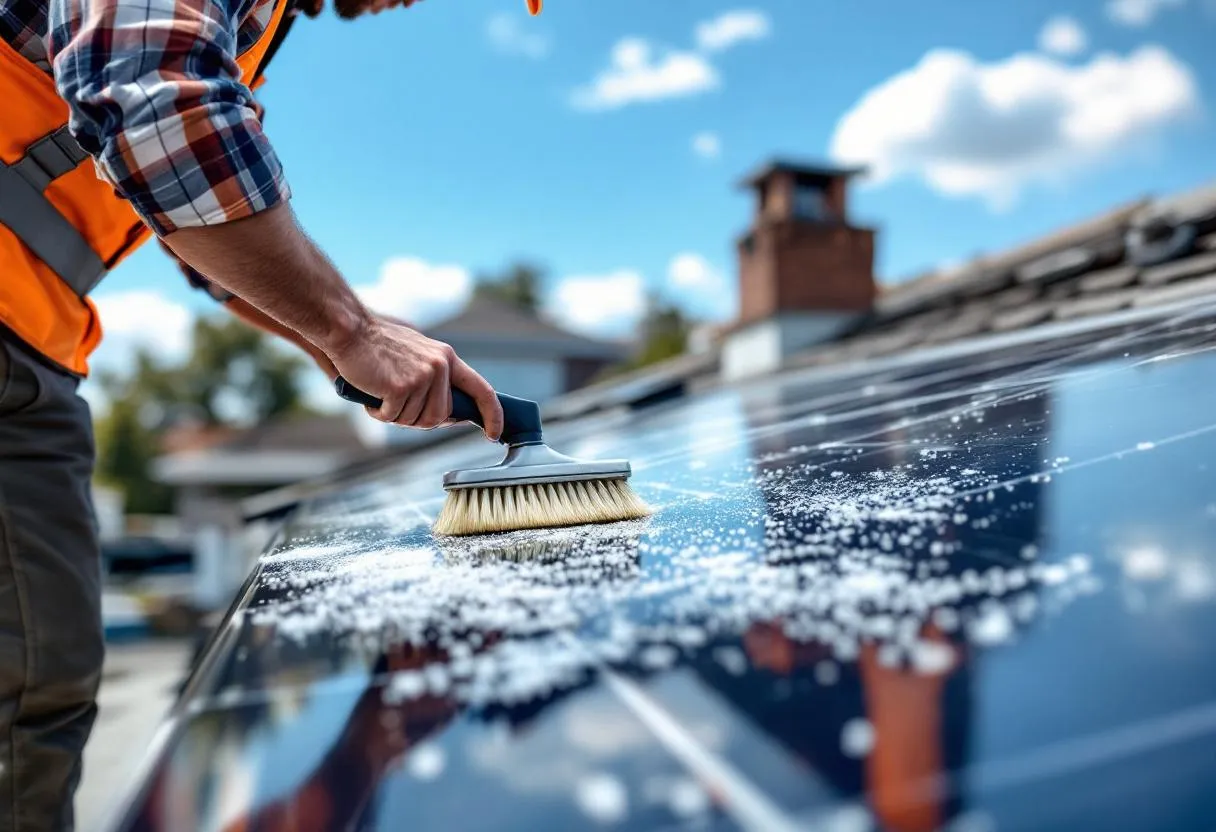
- Apply soapy water. Dip your soft brush in soapy water and gently scrub the panel surface in long strokes.
- Rinse again. Thoroughly rinse all soap residue off the panels with clean water.
- Let dry. Panels will air-dry naturally. If you want to avoid water spots, use a soft rubber squeegee.
- Check the ground. Clear any leaves, twigs, or debris from the areas surrounding and underneath the panels.
When to Hire Professionals
Consider hiring a professional solar cleaning service if:
- 🏠 Your panels are on a steep or high roof that makes ladder work unsafe
- 💧 You live in a hard-water area where tap water leaves mineral deposits
- 📐 You have a large system (20+ panels) that would take hours to clean yourself
- 🏢 You have commercial panels or a ground-mount system spanning multiple acres
Professional cleaners use deionized water and specialized equipment. The result is a spot-free shine that lasts longer than a DIY clean.
Monitoring Your System Performance
The best way to catch problems early is to watch your system's output. A drop in production often signals a problem before you can see it with your eyes.
Reading Your Inverter
Your inverter shows real-time power output in watts (W) or kilowatts (kW). Here is a quick way to check if things look normal:
Quick Output Check:
- → Find your system's rated capacity (e.g., 6 kW or 8 kW)
- → On a clear sunny day, output should reach 60-80% of that rating
- → A 6 kW system should peak at about 3.6-4.8 kW at midday
- → If you see much less than that on a clear day, something may be wrong
Clouds, shade, and cold (which actually helps panels) will affect this number. The key is to compare output on similar days — not to expect maximum output every day.
Using Monitoring Apps
Most modern solar systems come with a monitoring app. Popular options include:
| Platform | Used By | Key Feature |
|---|---|---|
| Enphase Enlighten | Enphase microinverter systems | Panel-by-panel monitoring |
| SolarEdge Monitoring | SolarEdge systems | Detailed energy flow visualization |
| Tesla App | Tesla Solar / Powerwall | Integrated solar + battery dashboard |
| Fronius Solar.web | Fronius inverter systems | Comprehensive production history |
Set up email or push notification alerts so the app tells you if production drops significantly. That way, you learn about problems even before they show up on your power bill.
Spotting Output Drops
Here are common reasons your output might drop, and what to do:
| Symptom | Possible Cause | Action |
|---|---|---|
| Sudden drop to zero | Inverter fault, breaker tripped, utility outage | Check inverter display and your breaker panel |
| Gradual decline over weeks | Dirt and dust buildup | Clean your panels |
| One panel much lower than others | Shade, dirt, or panel defect | Inspect the specific panel; check for shade or debris |
| Lower output only in winter | Shorter days, lower sun angle | Normal — compare seasonally, not month-to-month |
| Spikes followed by drops | Cloud cover passing overhead | Normal — wait for clear conditions to evaluate |
Seasonal Maintenance Schedule
Different seasons bring different maintenance needs. Here is a simple quarterly schedule you can follow:
🌸 Spring (March-May)
- 🧹 Full panel cleaning — remove winter dust and pollen buildup
- 🔍 Annual inspection — check all panels for storm damage from winter
- ✂️ Tree trimming — trim any branches that grew over the panels during winter
- 📱 Reset monitoring app — review winter production data and set new alerts
☀️ Summer (June-August)
- 🧹 Quick rinse after dust storms or extended dry periods
- 🔌 Check inverter — make sure it is not overheating in peak summer heat
- 📊 Review output data — summer should be your highest production months
- 🐝 Check for nests — birds and insects love the warm underside of panels
🍂 Fall (September-November)
- 🍃 Clear leaves and debris from panel edges and mounting gaps
- 🔍 Visual inspection — look for any damage that appeared during summer
- 📄 Review warranty info — know what is covered in case winter storms hit
- 🧹 Second cleaning — clear pollen, dust, and film before winter sets in
❄️ Winter (December-February)
- ❄️ Remove snow if safe — use a soft roof rake from the ground (never climb on a snowy roof)
- 🔌 Check inverter — verify it is still running on clear winter days
- 📊 Compare to last winter — check if production is consistent year-over-year
- ⚠️ Watch for ice dams — ice buildup on panel edges can cause long-term damage
📅 Quick-Reference: Year-at-a-Glance
| Task | Spring | Summer | Fall | Winter |
|---|---|---|---|---|
| Deep cleaning | ✅ | — | ✅ | — |
| Quick rinse | — | As needed | — | — |
| Full inspection | ✅ | — | Quick check | — |
| Monitor output | ✅ | ✅ | ✅ | ✅ |
| Snow removal | — | — | — | As needed |
When to Call a Professional
Most solar panel maintenance is DIY-friendly. But some issues require trained technicians with proper safety equipment and electrical training. Call a pro if you see any of these:
Cracked or Broken Panels
If a panel has a visible crack, shatter, or broken glass:
- 🚫 Do NOT touch it. Even cracked panels can carry live DC voltage up to 600 volts.
- 📸 Take photos for your warranty claim or insurance record.
- 📞 Call your solar installer immediately. Many repairs are covered under warranty.
- 📄 Check your policy — homeowners insurance may cover storm, hail, or fallen-tree damage.
Inverter Failure
Your inverter has an expected lifespan of 10-15 years — shorter than your panels. Signs of inverter failure include:
- 🔴 Red warning light that does not clear after a reset
- 💀 Complete zero output on sunny days
- 🔊 Unusual buzzing, clicking, or burning smells from the inverter box
- 📱 Monitoring app showing "offline" status for more than 24 hours
Cost to replace: $1,000-$3,000 depending on the model. Check your warranty first — many inverters are covered for 10-12 years.
Warranty Claims
If a panel is underperforming or showing defects, do NOT try to fix it yourself. DIY repairs can void your warranty. Instead:
- 📋 Gather documentation — serial numbers, installation date, purchase records
- 📊 Provide output data — monitoring app history showing underperformance
- 📸 Submit photos — clear images of the defect (crack, hotspot, discoloration, etc.)
- 📞 Contact the manufacturer or your original installer to start the warranty process
Other Situations Requiring a Professional
- ⚡ Any exposed wiring or sparking — shut off your system at the breaker and call an electrician
- 🐦 Animal nesting — squirrels, raccoons, and birds love to nest under panels. A pro can safely remove them and install deterrents (mesh skirts, bird spikes).
- 🔧 Loose mounting hardware — if panels feel wobbly or shifting, the mounts may have loosened. This is a safety risk during storms.
- 🏠 Roof work near panels — if you need roof repairs or re-shingling, hire a roofer who knows how to work around solar panels.
Maintenance Costs: What to Expect
DIY: $150-$300/Year
If you do the work yourself:
Most supply purchases are one-time. Subsequent years cost just $20-$40 for cleaning supplies.
Professional: $200-$500+/Visit
If you hire out the work:
Professional services are recommended if panels are on a steep roof or if you are not comfortable on a ladder.
💰 Maintenance Cost vs. Panel Value
To put these numbers in perspective:
| Item | Cost | Value Delivered |
|---|---|---|
| DIY maintenance (25 years) | $500-$1,500 total | Protects $15,000-$30,000 system; maximizes energy output |
| Pro maintenance (25 years) | $4,000-$10,000 total | Same benefits, with professional expertise and safety |
| Neglecting maintenance | $0 up front | 5-25% output loss over time; faster degradation; potential warranty issues |
Even at the high end of professional costs, annual maintenance is less than 0.5% of your system value — a tiny price to pay for decades of reliable, free solar energy.
💡 The Bottom Line
Spending a few hours a year on basic maintenance — or paying $200-$500 for a professional visit — protects a $15,000+ investment and keeps your panels producing at their best for 25+ years. It is the easiest ROI you will ever get.
Frequently Asked Questions
How often should solar panels be cleaned?
Most solar panels should be cleaned 2-4 times per year depending on your location. Homes in dusty areas, near construction, or with heavy tree coverage may need quarterly cleaning. In rainy climates, natural rainfall may handle most of the washing, requiring only 1-2 manual cleanings per year.
Can I clean my solar panels myself?
Yes, most homeowners can safely clean ground-level or easily accessible solar panels. Use a soft brush, garden hose, and mild soap. Never use a pressure washer, abrasive scrubbers, or harsh chemicals. For roof-mounted panels on a steep roof, hire a professional if you are not comfortable working on a ladder.
Do solar panels require a lot of maintenance?
No — solar panels require very little maintenance. They have no moving parts to wear out. A basic annual inspection and periodic cleaning is usually all it takes. Most panels last 25-30 years with minimal upkeep. Your main tasks are checking for damage, monitoring output, and keeping debris off the surface.
How much does solar panel maintenance cost?
Professional solar panel cleaning typically costs $150-$300 per visit. A full professional inspection adds $100-$200. If you do it DIY, your total annual cost is around $150-$300 the first year (including supplies) and just $20-$40 in following years.
What should I do if a solar panel cracks or breaks?
If a panel cracks or breaks, do NOT touch it. It may still carry live electrical current. Take photos for documentation and contact your solar installer or warranty provider immediately. Most panels come with 10-25 year warranties. Storm or impact damage may be covered by your homeowners insurance.